

On Proving Ourselves and Letting Go
My Paris Review Interview with Javier Marias

I’ve been thinking a lot about the interviews I did for The Paris Review in the 2000s—six total, including Nobel laureate Kenzaburo Ôe, Pulitzer-prize-winner Marilynne Robinson, National-Book-Award winner Ha Jin, and poet laureate Kay Ryan.
If you don’t know them, Paris Review interviews are it when it comes to author interviews. Since the magazine’s first interview with T.S. Eliot in 1953, they’ve featured everyone from William Faulkner to Toni Morrison to Stephen King.
That might sound dull to some of you, but Paris Review interviews are epic. The process is beyond lengthy. The author and interviewer meet over several sessions. (Marilyn Robinson and I had eight sessions.) Then the interview is heavily edited to read as a single conversation.
And then there’s everything that happens behind the interview, the strangeness of spending time with someone, hearing them talk for hours, but never really getting to know them or sharing anything about yourself.
I wrote a bit about my 2005 interview with the Spanish novelist Javier Marías a few years ago on Substack Writers at Work with Sarah Fay and spent this morning writing through it again, trying to get at what else was happening during the three days I spent interviewing him.
I arrived at Marías’s apartment building just off the Plaza Mayor in Madrid at six in the evening. The light was just starting to fade. The doorman, an elderly Madrileño, ushered me upstairs. The enclosed stairwell was dark. I could barely see the stairs and kept thinking the Madrileño was going to trip and fall.
In Europe, Marías had the celebrity status of a rock star. His books had been translated into over thirty languages and had sold over five million copies worldwide. (He was also the king of Redonda, an uninhabited Caribbean island—long story.)
Earlier that day, while eating lunch at a nearby restaurant, the waiter asked what I was doing in Spain. When I told him that I was in Madrid to interview Javier Marías, he gasped and said, “Sometimes we see him walking down the street!”
I probably shouldn’t have been interviewing such a famous writer. I’d interviewed only one other writer in my life, also for the magazine: the extraordinary poet Jack Gilbert, and I’d talked my way into that one. (Longer story, which maybe I’ll also dig into.)
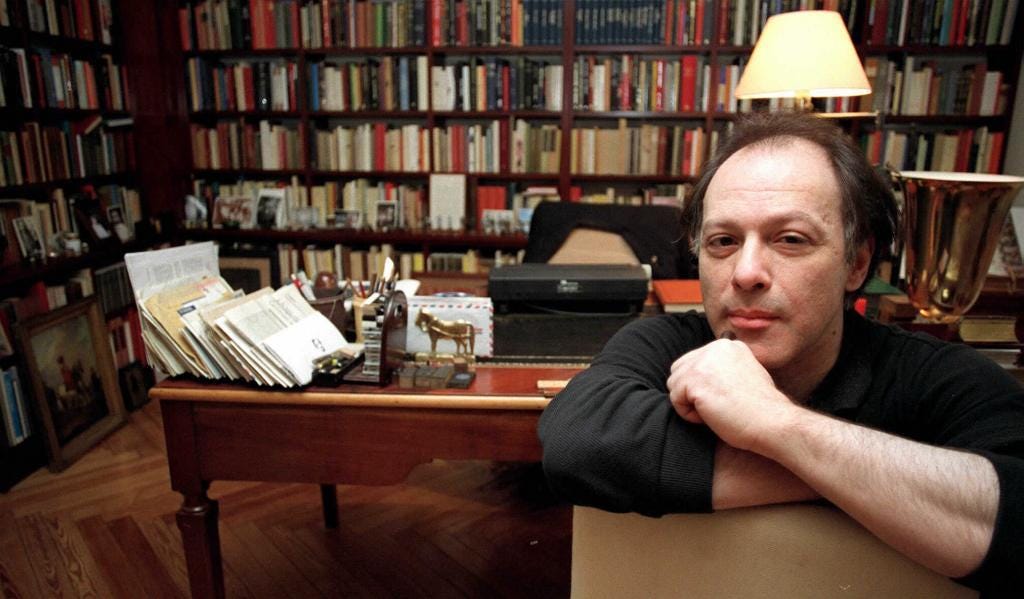
Marías answered the door and politely invited me inside. His eyes were puffy with dark circles under them, and though balding, he had a severe case of bedhead.
As we walked through the hallway of his apartment, Marías explained that Orson Welles’s Othello had been on television at three that morning, and he hadn’t gone to bed until six am.
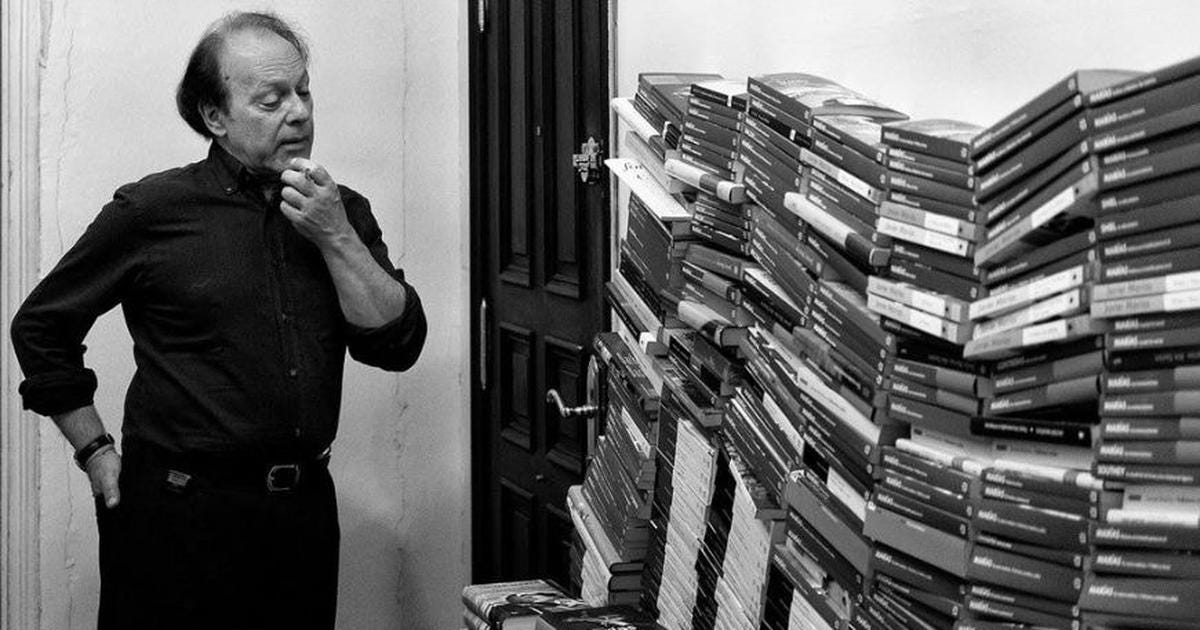
He squinted apologetically and quietly mentioned that his father had passed away a few months earlier.
“I sleep badly,” he said, gesturing for me to sit on a puffy blue chair.
What the interview, later published in the magazine, won’t tell you is that I’d walked the streets the night before, homesick and alone, worried I wouldn’t be ready, that the batteries in my tape player would die.
I don’t remember exactly, but if someone had videotaped us, I was probably perched on the edge of the chair, so wanting to prove myself.
I was militant in my preparation for the interview—a habit I’d continue. I’d spent three months reading all eleven of Marías’s novels; his two collections of short stories; reviews of his work; and every interview with him that had been published in English.
The pressure came from the magazine too, not the editors but because of the prestige and the tradition I was now part of.
Marías sat on the couch, and his eyes brightened. He described at length how honored he was to have been chosen as the subject for a Paris Review interview. He lit a cigarette and through the haze of cigarette smoke, said he had read the Paris Review interview with Vladimir Nabokov many times.
The interview also won’t tell you how sick I felt—not having eaten much, not being well mentally, and wanting so much to be impressive, liked, something. Or that—at the same time—I was totally enamoured of him and this incredible opportunity I had.
Marías and I met over three days. By the time we finished, the transcript of our sessions was 30,000 words long—the length of a novella—that the managing editor Radhika Jones (also an epic editor) and I would curate and develop, keeping the his verbatim but moving sections around in chunks and simulating questions to get it down to 5,000 words that would make the reader feel like they’re in that smoke-filled room with us.
On the last day, during a rare lull, Marías stubbed out his cigarette, popped up, went to the kitchen, and returned with a thick bar of dark chocolate. After offering me some, he ate a few squares—like a mountaineer in need of an energy boost—and went on talking.
By nine o’clock, Marías’s energy started to fade. He said he’d promised to meet friends at the corner bar to watch fútbol. As he showed me to the door, he seemed exhausted. It was an expression of tiredness I’d see on other interviewees’ faces—the kind that comes from talking about oneself for too long.
The interview also won’t tell you what I mentioned before about how decentering it is to be with someone and never get to know them.
Maybe it was the wanting to prove myself. Maybe, if I’d been able to settle back in that chair, let it go a bit, I’d have learned more about him, maybe more about myself.
Or maybe not. That time was so foggy, so full of sweets (marzipan, lots of marzipan—and meringues, which I don’t really like but are like mainlining sugar) that I’d eat to try to calm myself down.
Or maybe that was the getting to know myself, a knowing that comes later, that feels too late but never is.
Thank you for reading!
This is a reader-supported publication. You can support my work by becoming a paid subscriber—
—or by buying (or gifting) a copy of my national bestselling memoir, Pathological.

I love hearing about your editing process on the interview. Weird to edit human speech, which is so damn human! Back in the day I edited the Playboy Interview (also a renowned q&a) with Michael Jordan, which Mark Vancil conducted across a season of Bulls games, especially on the road, when Michael actually had time to talk. I received a dozen transcripts, and had to knit them into coherent talk. Which I tried valiantly to do, while honoring Michael’s actual words. I was super nervous when we published, because in some sense I had created Michael Jordan in the editing process. Reassurance arrived quickly: Michael said it was the best piece about him ever done. He later turned the interview into a coffee table book. Whew!
Am excited to read the interview you did with Marias now that I have the inside scoop! I love your Kenzaburō Ōe interview.